Showing posts with label iranian movies. Show all posts

Monday, August 4, 2008

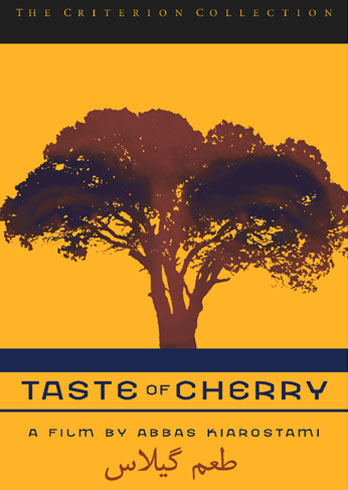
Taste of Cherry


“ The taste of mulberries saved my life
Don’t you want to watch the sun rise, watch the moon and stars at night?
Don’t you want a taste of cherry?”

These words perhaps changed Mr. Badii’s life and brought him back from the brink of his death. We’ll never find out for sure. But we can hope.

I have written before about Iranian movies and how they push the envelope of conventional filmmaking. Abbas Kiarostami’s Taste of Cherry is another film that makes you rethink the scope and appeal of cinema. A movie need not tell a story every time. You might as well read a novel or a short story if you want that. The scope of celluloid is much bigger than just story-telling. A film can be a simple slice of life. A piece cut out from the fabric of everyday life, with ordinary people, with common hurts and pains held up on the screen with extreme deftness and clarity. Iranian films have done that for me.

Mr Badii drives around the dry dusty landfill just outside the city in his Range Rover, with sad sunken eyes and a brooding mood that reflects the harsh, parched earth that he drives around on. He accosts strangers working at the landfill with a strange request. He has identified a spot by a tree on the hill where there is a hole in the ground and he will take a doze of sleeping pills and lie down in this hole for the night. All he asks of the stranger, for a sum of 200,000 tomans, is to come and see if he’s alive the next morning and if he does not respond, to throw some earth on his grave.

We do not find out what the reason for his request is. The viewer is not given the option of judging Mr Badii to pass a verdict on whether his pain is strong enough to warrant suicide. As if you can ever judge that. Like Mr Badii’s character says as he was trying to convince a religious student to carry out his request: what is the use of my telling why I would like to commit suicide, you can understand my pain, sympathize with me, but can you ever feel what I am feeling?

He finally convinces an aging taxidermist at the Natural History Museum to help. The old, wizened man tells Mr Badii about his own failed suicide attempt. He tells how he could not get the rope to hang from the tree and when he climbed up to tie the rope, his hands touched a bunch of mulberries. He ate some and watched the sun rise in the horizon; then he heard below a group of school children asking him to shake the tree for the mulberries. Could he forego the taste of cherries, forego watching the sunrise and the stars and moon at night?

The entire movie is shot in this dusty hill with winding roads and rocky bypasses. It is just outside the hustle and bustle of the city, which can be seen in the distance. The sounds of life like the barking of a dog, children playing, soldiers doing their routine, rhythmic marching practice are juxtaposed with the eerie silence of the dry patch of land. This juxtaposition seems to echo Mr Badii’s inner turmoil: a place on the verge of life and death, between silence and sounds. The silence is only heightened by his car tires screeching on the dusty roads and the rock-crushing machine.

In spite of the ruthlessness of the terrain, you cannot help notice the allure of the earth that is a playground for children, a marching ground for the soldiers and a source of livelihood to many working at the landfill. Even the withered, scorched landscape looks beautiful in the light of the setting sun.

And as Mr Badii gives a ride to the taxidermist into the town and stops to watch the sunset, you can’t help but hope that he does not go through with his decision to quit, to let-go completely. You are reminded of the taste of cherries and filled with immense joy and gratitude for everything in life.

Tuesday, July 29, 2008

Weekend Film-fest


My weekend usually comprises a healthy dose of doing nothing and watching movies. This weekend was no different. I watched three movies, all three very different and intriguing. I’d like to write about two of them here.

First, is an Iranian movie called “The Mirror”. Ever since I watched Majid Majidi’s “Children of Heaven”, I have sought out every opportunity to watch movies by Iranian filmmakers. I have watched movies by the Makhmalbaf father and daughter duo, Moshen and Samira, by Jafar Panahi and Majid Majidi, whose work really drew me into Iranian new wave cinema, as their work is often called. I am yet to watch many of their best movies. However, the ones that I have watched have been really special in their beauty and cinematic appeal. A movie, irrespective of its genre, has a very special appeal that cannot be compared to any other medium. A movie cannot be compared to a novel or an essay or a song because every medium has its own characteristic and appeal. “The Mirror” turns this cinematic experience on its head and the audience is as much bewildered as entertained.

The story overtly is about a little girl whose mother is late in picking her up one day after school. After waiting long for her mother to arrive, she decides to find her way back home. The first half of the movie is about her experiences about trying to find her way home amidst the hustle and bustle of Teheran, a big city like any other. Like any big city, it is intimidating to a child, especially one like little Mina who doesn’t even know her address and only has a vague about where to go. She gets on a bus and is a silent spectator to the drama of everyday life: a palm-reader who advises a woman how to catch her cheating husband, an old lady who complains about her ungrateful son and daughter-in-law who are too ashamed to introduce her to their neighbors, a couple of young lovers who exchange silent glances from the men’s and ladies sections of the bus. Mina watches them all.

Just when you get all involved in the film and are wondering how is Mina going to find her way back, something extraordinary happens. Mina looks straight into the camera and declares that she doesn’t want to act anymore! The viewer is taken aback to find that people behind the camera, who are now in front of it, are trying hard to get Mina to act and continue filming the movie. One member of the crew, a woman, is sent to find out what’s wrong with the girl and coax her into coming back into the set. Mina refuses. She is very upset and wants to go home. She changes into her own clothes and starts making her way into the Teheran traffic, which is a important protagonist in the movie. Interestingly, she still has the microphone strapped to herself, so the crew decides to follow without her knowledge, or so we think! What follows now is a mirror-image of the first half of the film as Mina once again tries to find her way home. Suddenly there is a film within a film or should I say a documentary within a film, if we are to believe that Mina is no longer acting and this is not the film we were watching. At some point in her convoluted journey (she still doesn’t know her own address and fumbling her way through the big city), Mina meets the old lady who was in the bus. She tells Mina that she was paid some money and asked to come to the set. So Mina asked if she left because she didn’t like the lines they gave her to speak to which the lady replies that she wasn’t given any lines to speak and what she was saying was true. In one stroke, not only is the cinematic medium challenged by blurring the lines between reality and illusion, the film also becomes a sort of commentary on contemporary life in Iran.

Mina does find her way back home eventually but is it really her home? Is she really Mina? Is this also a part of the film or it is as spontaneous as the viewer is made to believe? This is the magic of cinema as in spite of so many unanswered questions, the viewer is captivated by what’s transpiring on the screen. She is challenged to stretch her ideas about art and reality, about feature and documentary. The sense of concern for Mina’s safe return home does not change: the viewer is still worried about a little child getting lost in the mean streets of a big city; however, it no longer remains the film we set out to watch. Several characters walk in and out of the movie but the camera for the most part remains on Mina. A simple journey back home becomes a fascinating process on the nature of film itself.

The next movie I watched is a Japanese blood-fest called “Audition”. The write-up on the DVD jacket warned me of a psychological thriller. As the movie progressed and nothing extraordinary happened, I relaxed a bit. I guess this was exactly what the makers wanted. The story is about a widower in his 40s who is urged by his teenage son to find a girlfriend decides to hold a fake audition with the help of a friend in the movie business. He and the friend interview many women all day but this particular girl, Asami, grabs his attention with her demure manners and shy smile. He decides to ask her out and tell him that there’s no movie but that he’s interested in her. His friend senses something is amiss with this girl and urges his friend not to meet her. But of course, the guy succumbs. The first scene where I really got scared is when Asami is shown sitting on the ground in this loft sort of a place with her head down and her hair covering her face. On the far ground is an old-fashioned phone and beside it a sack, tied up at the end. The phone rings and rings and finally Asami lifts her face and smiles a sinister smile and at that exact moment the sack moves! I jumped from my seat and can feel the sensation as I write this down.

The rest of the movie unravels the mystery of Asami who we find not to be a shy, demure girl at all but this crazed woman with a disturbing past. Several characters are introduced and the jigsaw puzzle that is Asami is revealed, one gory piece by piece, literally. The climax of the movie is a 15-minute scene of torture, blood and pain that Asami inflicts on our hapless non-hero. It is blood-curdling at times but I had expected it. To call this a scary movie is an understatement. But it is not in the genre of the mindless slasher-horror movies that Hollywood has given us.

It’s said that Quentin Tarantino was inspired by Japanese movies to make his very popular “Kill Bill” series and “Pulp Fiction”. Japanese movies have a rich tradition of stylized violence. They have given the world the manga and the anime and I’m pretty sure Tarantino watched the “Audition” when he was doing research for his movies.